

Why material procurement decides whether a Syrian project stays on programme
Most budget arguments on a renovation or build do not start at handover. They start weeks earlier, when stone was ordered from the wrong batch, joinery was released before samples were signed, or a long-lead item arrived after ceilings were already closed. Construction material procurement Syria owners can trust is not a shopping list — it is a sequenced decision path tied to the programme, the written scope, and the people authorised to approve spend.
Procurement also decides how much improvisation happens on site. When materials arrive late, mismatched, or without a recorded substitute rule, trades fill gaps with whatever is available. That is when quality drifts, snags multiply, and the owner discovers that "the same marble" was never the same slab. Planning alternatives before bulk order is cheaper than explaining variances at project handover.
This playbook focuses on procurement gates inside wider construction project management in Syria. It complements scope writing and timeline staging — but the daily discipline lives here: what may be bought, when, from which approved option, and with what evidence when it lands on site.
Anchor every purchase to the scope of work
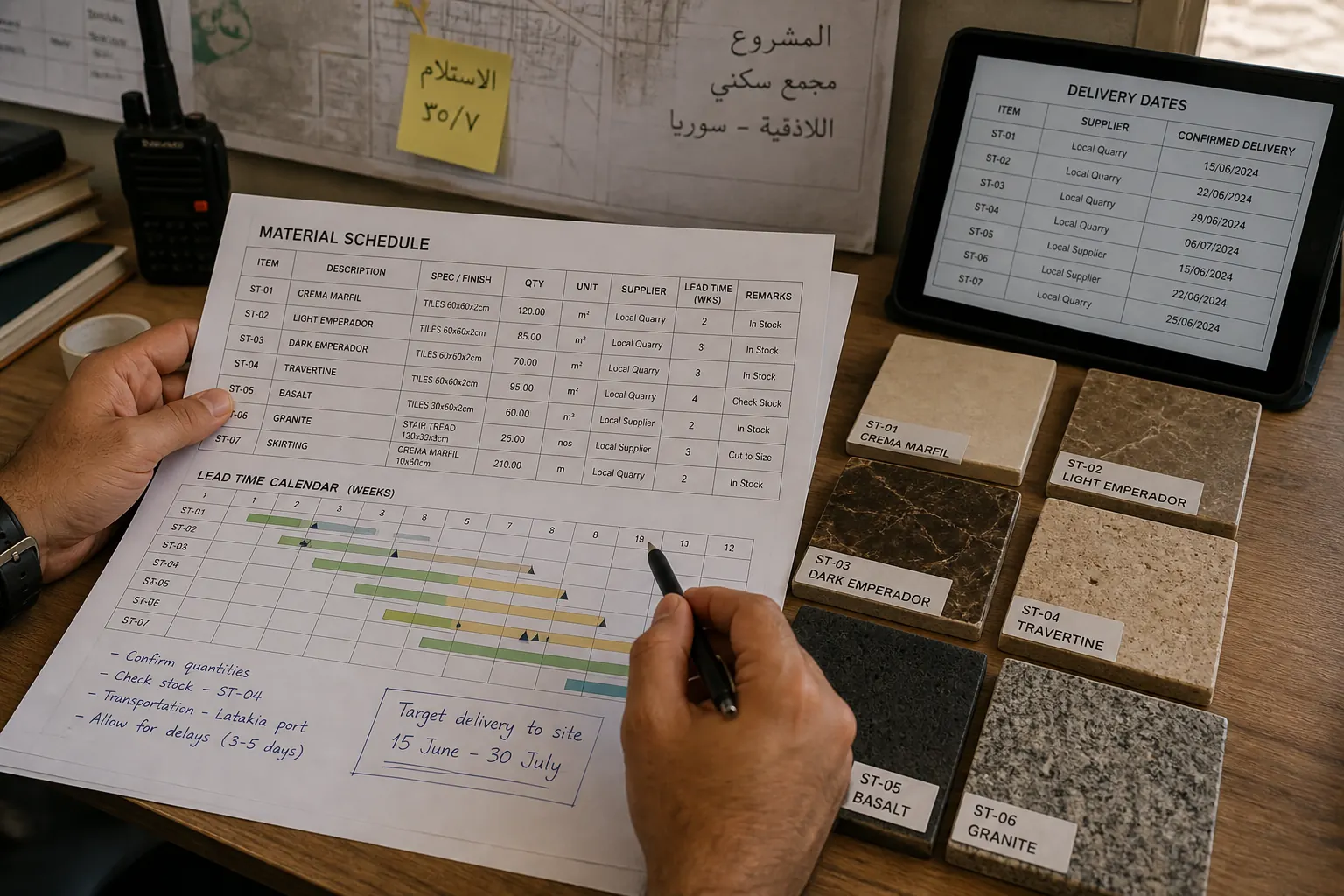
A material line only protects the budget when the scope of work can test it. If finishes are described as "premium" without a schedule, procurement becomes opinion. Write the scope with measurable packages first — locations, trades, performance, allowances, exclusions, and substitution rules — then attach a finish and material schedule the buyer can release against.
Each line should name the item, intended location, dimensions or performance where relevant, approved sample status, supplier if known, and whether the owner or contractor selects and pays. Provisional sums should stay labelled as provisional until a sample and price delta close the allowance. Without that link, a purchase order is just a receipt, not a control document.
The construction scope of work guide shows how to write those measurable lines. Procurement should never run ahead of a scope revision the owner has approved.
Plan alternatives before bulk order, not after a delay
Alternatives are not a failure of design. They are how a programme survives stock changes, batch variation, and lead-time slips without forcing rushed decisions on site. For each critical material — stone, tiles, sanitaryware, doors, lighting, joinery veneers, mechanical equipment — record a primary selection, one or two pre-approved substitutes, and the rule for proposing anything outside that list.
Compare substitutes on dimensions, performance, maintenance, compatibility with adhesives or substrates, visual effect under the project's lighting, warranty availability, cost delta, and delivery date — not on a single phone photo. A substitute that fits the wall size but fails the slip rating in a wet room is not equivalent. Write the comparison fields once in a template so every proposal is reviewed the same way.
Batch-sensitive materials need explicit language. Natural stone, wood veneer, and some tile ranges vary between lots. The schedule should state whether matching continuity is required across rooms, how many spare boxes or slabs will be held, and who approves a batch change before cutting or installation begins.
Build lead times into the programme, not beside it

Lead time is a programme fact, not a supplier promise in isolation. Map critical path items onto the staged calendar: items needed before first-fix MEP, before waterproofing close-up, before joinery shop drawings freeze, before final flooring, and before handover spares. If approval sits two weeks before release and fabrication sits six weeks after, that eight-week window must appear on the timeline — not inside a footnote.
Use the same stage names as your construction timeline in Damascus so owners see procurement milestones beside site gates. Late sample sign-off is a timeline event. So is a supplier slip that pushes ceiling closure.
Construction management should maintain a live procurement register: item, scope reference, approval date, order date, promised delivery, actual delivery, storage location, and status. One register prevents duplicate orders, forgotten spares, and trades claiming they cannot proceed while materials sit un inspected in a corridor.
Pre-bulk procurement checklist
Before releasing a bulk order, confirm: scope revision approved; material schedule line referenced; sample signed with date and photo in consistent lighting; primary and substitute options recorded; quantity survey checked against net areas and waste allowance; interfaces confirmed with adjacent trades; storage and protection on site or off-site assigned; delivery window agreed with site supervision; and one named owner approver on file.
If any line fails the checklist, hold the order. Expediting fees and site idle time usually cost more than waiting for a signed sample or a corrected quantity. Emergency orders should carry a written exception — cause, approver, and impact on cost and programme — the same discipline used for scope changes.
Owners abroad should batch finish decisions in milestone packs rather than item-by-item messages. The remote materials approval guide explains how to structure those packs so procurement does not pause while WhatsApp threads catch up.
How site supervision checks deliveries

Site supervision is the receiving gate. Deliveries should not enter finished routes without inspection: check quantity against the order, batch or shade references against the approved sample, damage, moisture exposure, and correct labelling for room or package. Reject or quarantine mismatches before trades cut or fix the material.
Photograph deliveries with the delivery note visible, the batch label readable, and the storage location recorded. Those images belong in the weekly report — not only in a supervisor's camera roll. If material must acclimatise — stone, wood, some adhesives — supervision should enforce storage conditions before installation is released.
That evidence rhythm sits inside HYMRO's construction process: hold points before cover-up, labelled photography at gates, and no finish work proceeding on unapproved stock.
What project handover should record about materials
Project handover should prove what was installed, not what was intended on day one. Include the approved material schedule with revision dates, closed substitution log, delivery records for critical items, spare boxes or slabs transferred to the owner, maintenance notes for stone and joinery, and supplier contact references where warranties apply.
If a provisional allowance closed with a specific product, the handover pack should show that closure — sample photo, approval date, and as-installed location. Future maintenance teams should not guess which tile batch or marble lot was used in a wet room.
On larger residential programmes — such as a Damascus villa restoration — material records are part of the same handover discipline as snag closure and testing certificates. Procurement paperwork is handover paperwork.
Keeping procurement controlled when you are not on site
Remote owners should receive bilingual procurement packs: sample photos in consistent lighting, side-by-side alternatives, cost and lead-time comparison, recommended choice, and a clear approve-or-defer action. Voice notes add context; they do not release purchase orders. Align family comments into one weekly decision window so site supervision is not reversing orders mid-programme.
HYMRO coordinates procurement inside project management for overseas Syrians. Send your scope baseline, target handover date, and any materials already selected via contact so the first programme includes procurement gates — not a headline price that ignores lead times.