

Contractor vs project manager Syria: the decision before the quote
The contractor vs project manager Syria question usually appears too late. Many owners first ask it after receiving a lump-sum price, a WhatsApp list of inclusions, or a promise that "everything is covered." By then, the commercial structure is already shaping the project: the person delivering the work may also be the person reporting whether that work is on time, on budget, and built to the agreed standard.
A contractor is responsible for carrying out defined works through labour, subcontractors, materials, and site coordination. A project manager represents the owner's programme: defining the scope of work, comparing delivery options, managing approvals, tracking cost and time, and pushing the project towards documented project handover.
Neither role is automatically better. A straightforward repair can succeed with a capable contractor and a clear brief. A villa renovation, commercial fit-out, diaspora-owned property, or phased build usually needs construction management that is not financially blurred with every site instruction.
What a contractor is accountable for
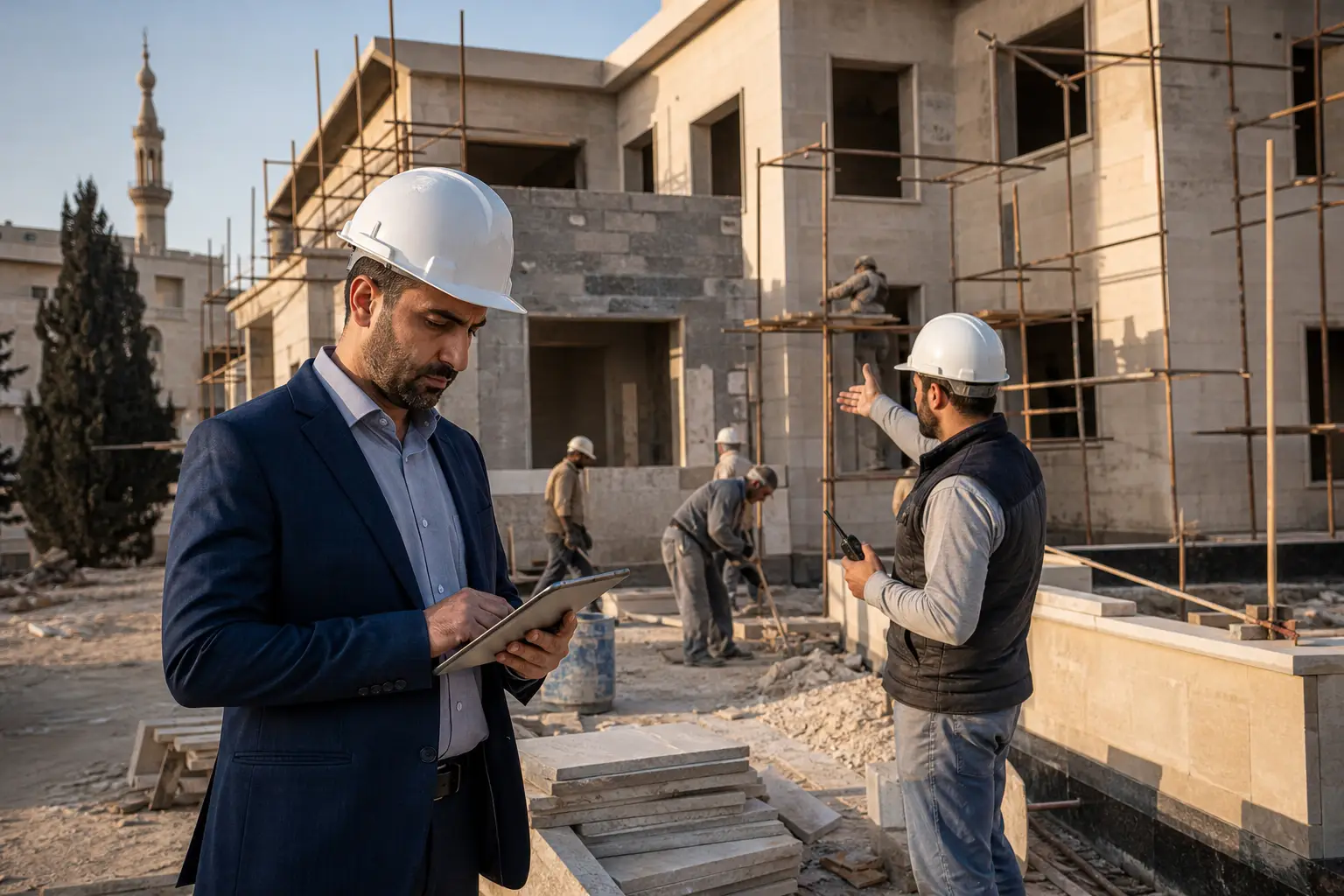
A contractor's core obligation is execution. Once the scope is agreed, the contractor organises trades, purchases materials, sequences day-to-day activity, and delivers the physical works. Good contractors bring practical knowledge that drawings alone cannot provide: how a wall is likely to behave once opened, which finish detail will be difficult to maintain, and where a proposed sequence may cause rework.
The risk is not the contractor role itself; the risk is asking one party to price, judge, approve, and report on its own work without enough checks. If the quote is vague, the cheapest number may exclude protection, testing, finishing standards, cleaning, waste removal, or post-handover defects response. Those omissions do not disappear. They become variations, delays, or arguments when the site is already active.
Before appointing a contractor in Syria, owners should ask for a written inclusions list, exclusions, material assumptions, payment stages, variation rules, and responsibilities for permits or third-party interfaces where applicable. That clarity protects both sides.
What a project manager protects
A project manager protects the decision system around the build. That includes scope of work control, cost reporting, programme sequencing, approval gates, site supervision, and handover documentation. The project manager should not simply repeat what the contractor says; the role is to test progress against agreed evidence.
In practice, that means asking whether the correct material has arrived before installation, whether first-fix services have been inspected before ceilings close, whether a variation affects the programme, and whether a milestone invoice matches measurable completion. For overseas Syrian owners, it also means translating site reality into structured updates that can be approved from abroad.
HYMRO's project-management service is built around this owner-side control. It does not replace good contracting. It gives the owner a clearer way to appoint, supervise, challenge, and close the work without relying on informal updates alone.
Scope of work is where the roles separate

The scope of work is the most important boundary between contractor and project manager. A contractor prices and delivers against it. A project manager helps define it, test whether it is complete, compare offers on equal terms, and keep later changes traceable.
For a residential renovation, scope may include demolition, structural repairs, MEP routing, waterproofing, floor build-up, joinery, lighting, sanitaryware, painting, protection, cleaning, and snagging. For a commercial project, it may add landlord approvals, branding interfaces, access hours, fire-safety coordination, and opening-date constraints. If those items are hidden inside one broad sentence, the quote cannot be properly compared.
Owners should resist starting work from a mood board and a total price alone. A practical scope sets measurable milestones: survey complete, demolition closed, first-fix inspected, finishes approved, systems tested, snag list issued, and project handover signed. That sequence gives both contractor and manager a shared frame.
Site supervision is not the same as project management
Site supervision focuses on what is happening on site: trade attendance, quality checks, sequencing, safety routines, delivery inspections, and daily problem solving. It is essential, but it is narrower than full construction management. A supervisor may know that plastering should stop because services are not tested; a project manager also records the cost, time, approval, and contractual impact of that stop.
For smaller works, experienced site supervision may be enough if the scope is tight and the owner is available. For complex or remote-owned projects, supervision should feed into a wider reporting structure: weekly progress summaries, photo evidence by zone, decision logs, variation registers, and milestone sign-off.
This distinction matters because owners often pay for "management" but receive attendance. Ask what reports you will receive, who has authority to reject non-conforming work, how issues are escalated, and whether the same person approving progress is also responsible for delivering it.
When owners abroad need independent reporting
Distance changes the risk profile. A local owner can visit, ask questions, and see whether a promised crew is actually on site. Owners abroad need reporting that compresses that visibility into evidence: dated photos, short video walkthroughs, marked-up plans, approval requests, and clear next actions.
The overseas-Syrians workflow is especially sensitive to role confusion. A contractor may send photos of attractive progress while leaving hidden services, delayed procurement, or unresolved variations unexplained. A project manager should show both progress and exceptions, because the owner's decision depends on the full picture.
A good reporting rhythm reduces emotional pressure. Instead of approving costs through scattered messages, the owner receives a structured pack: what changed, what is blocked, what needs approval, what the financial impact is, and what happens next week.
Project handover proves whether management worked

Project handover is where the difference becomes visible. A contractor may hand over keys and a verbal explanation. A managed project should close with a snag list, completion status, warranty contacts where available, care notes for finishes, as-built MEP information where relevant, and a defects-period process.
The handover pack does not need to be theatrical. It needs to be useful. If a pump fails, if a stone sealant needs care, if a hidden access panel must be located, or if a tenant asks what was installed, the owner should not have to reconstruct the history through old messages.
For HYMRO clients, this closing discipline links the process page to long-term asset care. The build is not truly finished when the final trade leaves; it is finished when the owner can operate, maintain, and prove what was delivered.
How to choose the right structure before building
Use a contractor-led structure when the work is narrow, the scope is already documented, the owner can inspect regularly, and the consequences of variation are limited. Examples may include isolated repairs, small finishing packages, or maintenance tasks with known conditions.
Use project-management support when the project has multiple trades, owner approvals from abroad, unclear site conditions, premium finishes, tight sequencing, or a handover standard that must be documented. The cost of management should be judged against the cost of uncontrolled variations, delayed decisions, and weak records.
Before you build, ask HYMRO to review the brief, desired outcome, location, budget range, and decision constraints. The right answer may be a contractor with a tighter scope, owner-side project management, or a combined delivery approach with transparent reporting from first inspection to handover.